
Tal Kattan
Deputy Head & Head of Hebrew, King David Primary School Linksfield
In recent years, Jewish educators have spoken extensively about resilience. We seek to develop resilient students and communities, and to ensure the flourishing of Jewish life in an increasingly complex world. Yet resilience in Jewish education is not sustained by values alone. It depends on the successful transmission of language, culture, memory, and identity from one generation to the next. And Hebrew is the lifeline that makes that transmission possible.
Hebrew is far more than a subject in the curriculum. It is the language of our prayers, our sacred texts, our history, our modern culture, and the State of Israel. It connects Jewish students to thousands of years of collective memory while enabling them to engage meaningfully with Jewish life in the present. If resilience is the ability of a people to preserve and renew itself across generations, then Hebrew is one of the most powerful tools through which that resilience is sustained.
I was recently asked to share some of the practical steps I have taken as Head of Hebrew to strengthen the status of Hebrew and ensure that it remains visible, valued, and alive throughout the school.
*This is a translation. If you would like to read this article in the original, please toggle to the Hebrew version. חוסן החינוך היהודי מתחיל בעברית – מבט מדרום אפריקה
For nearly eight decades, the King David Schools in Johannesburg have constituted a network of Jewish schools operating under the auspices of the South African Board of Jewish Education. The network includes four campuses and offers co-educational education from preschool through high school; today, approximately 2,300 students study there and approximately 360 teachers teach there. The schools operate in an Orthodox-traditional spirit, while remaining open to and welcoming students from diverse Jewish backgrounds. Alongside an excellent general education, significant emphasis is placed on Hebrew and Jewish studies, as part of an educational outlook that sees language, tradition, and the connection to the State of Israel as central components of students’ identity. Within a cohesive Jewish community with clear expectations, the schools aspire to educate students with Jewish identity, a sense of belonging, and responsibility toward the community and society.
When I began leading the Hebrew department at the school, I understood that the question was not how many hours of Hebrew are taught—although that, too, is an important question—but what status Hebrew holds in the school’s culture. A language may be taught competently and yet remain confined to the boundaries of the classroom, detached from the broader rhythms and identity of school life. My aspiration was fundamentally different: that Hebrew would be present, visible, audible, and deeply felt throughout the day, and that its status would be unmistakably clear, firm, and unquestionable.
Hebrew: As Foundation and Core
The cultural ethos begins with school leadership. From the outset, the message conveyed by the school leadership has to be unequivocal: Hebrew is not an ancillary discipline within Jewish education, but its foundation and core. At assemblies, parent information evenings, school ceremonies, and in conversations with students, the importance of Hebrew is articulated consistently and intentionally. It is not treated as a supplementary subject alongside others, but as an integral expression of the school’s Jewish character and educational mission. It is the heart of school life.
This commitment is reflected not only symbolically, but structurally. Hebrew is taught five lessons per week, every school day, in addition to a dedicated Hebrew singing lesson. New students who have no prior background in Hebrew are also integrated into a dedicated stream that enables them to advance and participate—but opting out of Hebrew is not an option.
Every minute in a Hebrew lesson is precious—this message is conveyed to faculty and students alike, to ensure that the time is devoted to meaningful study of the language, culture, and heritage.
Strong Leadership as a Key Value
For the vision to be realised, strong leadership from the head of the Hebrew department is required. That person must stand behind the language, advocate for its status, secure support from management, and convey a clear message to the faculty, students, and parents.
Students and parents need to see that Hebrew is treated with seriousness and respect, and that those responsible for it view it as a central educational priority and as a pillar of Jewish identity and continuity. Decisions regarding resources, scheduling, and school programming all contribute to shaping the status of the language within the school. In many ways, the standing of Hebrew within a school is shaped less by declarations than by the daily choices that reveal institutional priorities.
Hebrew and the Culture of Excellence
The language is taught deliberately and with exacting standards. The demand for excellence is a foundational principle: precision, effort, and constant improvement. Students understand that Hebrew is a serious academic subject, and this sense of seriousness often strengthens their respect for and love of the language.
The choice to give Hebrew central status does not end with instructional hours. It is also expressed in milestone events.
At the Grade 7 valedictory, just before the transition to high school, only one subject receives dedicated award categories: Hebrew Excellence, Hebrew Achievement, and Hebrew Diligence. There are no parallel categories in other subjects.
This decision was not made in order to diminish the value of other subjects. It was made out of an understanding that in a Jewish school in the diaspora, Hebrew serves as a key anchor of identity. When a student walks onto the stage and receives an award for Hebrew, he understands that his Hebrew effort has public value.
The message to students and parents is clear: Hebrew is not a marginal field. It is core.
Hebrew on the Main Stage
At Yom Hazikaron ceremonies, Holocaust Remembrance Day ceremonies, and other events, it is clear: there is no literary reading, no song, and no textual excerpts without the original Hebrew. Even when there is a translation, the original is heard aloud.
More than once, I have heard the claim that students do not understand every word. Perhaps. But complete comprehension is not the only condition for meaning. Hearing the original language honours the text and connects students to Jewish history, tradition, and continuity across generations.
Care is taken to ensure that the Hebrew is clear, rehearsed, and polished. Students do not go up to read without preparation. The language is not presented as something incidental, but as something that must be handled with care. The precision itself conveys prestige.
One of the most meaningful initiatives is “Word of the Week” at the weekly morning assembly.
Each week, two students go up on stage and present a word in Hebrew through a short dialogue. The word appears on the screen in Hebrew, and sometimes additional sentences appear as well. The students do not read a technical text; they converse, present, and act with the language.
Over time, this initiative became a central moment in the assembly. The school principal even defined it as the “highlight” of the assembly. The moment school leadership gives public prestige to an activity in Hebrew, a clear message is created: Hebrew is not an add-on. It is the heart of the event.
Today I have a waiting list of students volunteering to present the Word of the Week. They want to be on stage in Hebrew. This is a cultural shift. The language has gained visibility and respect.
Hebrew is also integrated beyond designated Hebrew segments. Assembly slides and school presentations regularly include Hebrew terminology alongside English, regardless of the topic. Whether announcements concern sport, social activities, or school events, Hebrew appears naturally within the public space of the school.
In this way, repeated and consistent exposure is created—not dramatic, but meaningful.
Beyond the “Word of the Week,” we have occasionally chosen to bring Hebrew texts to life through drama. At assemblies, students have performed short adaptations of stories in Hebrew, from the poems of Leah Goldberg to the stories of Miriam Ruth and other works of Hebrew literature. The plays are conducted entirely in Hebrew. Students study the text, memorise it, understand it, and embody its characters. The moment a Hebrew text becomes movement, voice, and emotional expression on a stage, it stops being a page in a book and becomes a living, breathing experience.
Visual Presence: Not Only Learning, but Also Identity
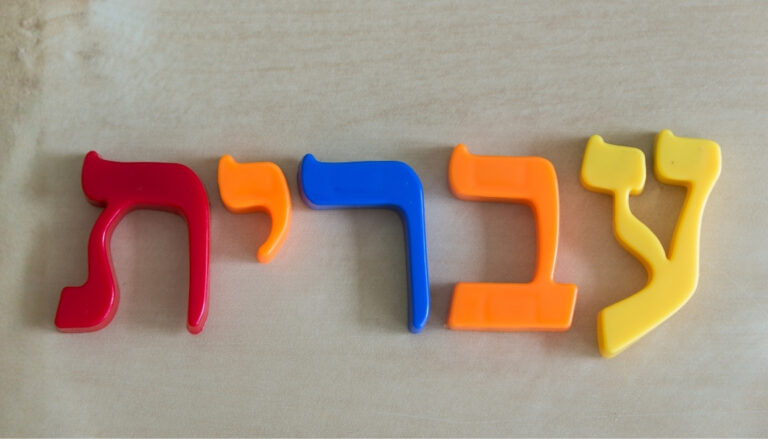
The visibility of Hebrew throughout the school environment is intentional. Every classroom contains a map of Israel, an Israeli flag, and Hebrew posters or displays. The connection between language, peoplehood, and land is therefore made visible within the learning environment itself.
I have often been told that posters in Hebrew do not actually teach. Even if, from a pedagogical perspective, the impact of the posters is limited, their cultural meaning is great. When a child enters a classroom and sees Hebrew on the walls, he understands that this language deserves a place. That it is not a guest.
The visual space creates a norm. It communicates that Hebrew is part of everyday life, not a one-time project.
This principle extends to communication with parents as well. The weekly school newsletter includes Hebrew headings, Hebrew dates, and occasional quotations. The purpose is not narrowly instructional, but cultural: Hebrew belongs within the public identity of the school.
A Policy That Does Not Fold
The deep change occurred when Hebrew was given a mandatory status at the systemic level.
Repeatedly, scheduling challenges emerge. Rehearsals for a play, special events, guest speakers. Each time, the same question returned: which lessons are canceled?
I made it clear that Hebrew is not the first to be pushed aside. It is a core subject. Not a slogan, but a policy. Hebrew lessons are not canceled in order to make room for other events. When adjustments to the schedule became necessary, solutions are sought that preserve Hebrew instruction rather than sacrificing it. The priorities in action reflects the priorities of values.
The students see this. They understand that the statement about the importance of Hebrew is not merely rhetoric. It is backed by decisions.
This is expressed in the examination system as well. Hebrew is not pushed to the end. It is given priority. When students see this, they understand the school’s true priorities.
Experiential and Dynamic Hebrew
I emphasise to my team that the goal is not only linguistic proficiency, but the development of a love of the language as well as a meaningful and dynamic relationship with it.
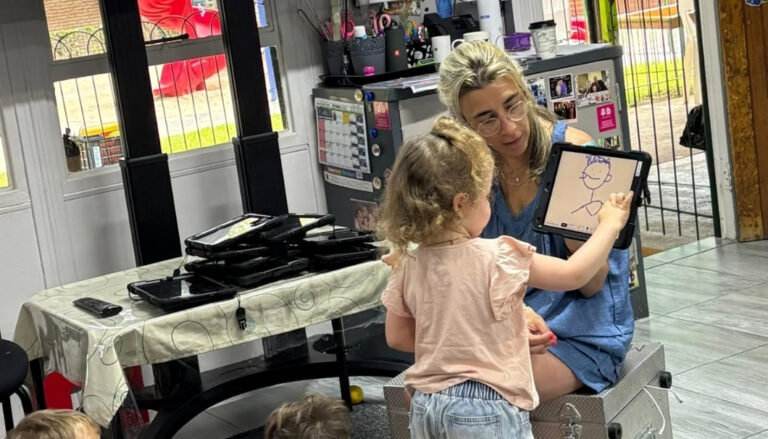
One approach involves the use of gamified learning. At the end of learning units, students review material through Hebrew Kahoot activities, combining competition with revision of vocabulary and grammatical structures. Hebrew thus extends beyond the pages of the textbook into digital environments familiar to students.
At other times, learning becomes more inquiry-based and experiential. During Tu Bishvat, for example, students scanned QR codes hidden around the classroom and followed Hebrew clues to learn about trees and flowers associated with Israel. Hebrew became a tool for exploration and discovery.
Sensory experiences are incorporated as well. Students studying food-related topics taste Israeli foods while discussing them in Hebrew. In units dealing with contemporary issues, such as protecting the environment and recycling, students create informational posters in Hebrew using digital tools such as Canva.
Cultural moments also become opportunities for deeper learning. Following the passing of Yehonatan Geffen, I paused the curriculum to introduce Grade 7 students to his contribution to Hebrew and Israeli culture. Students explored his song “The Little Prince,” discussed its connection to Antoine de Saint-Exupéry’s literary work, and examined broader themes related to society, identity, and emotion. Through such lessons, Hebrew becomes a space where language, literature, history, and culture intersect meaningfully.
In an age when vocabulary and language can easily be acquired through digital applications, the enduring value of Hebrew education lies in its connection to heritage, values, religion, culture, and the State of Israel. The language becomes a bridge between knowledge and experience, between the classroom and life itself. Love of the language develops out of this experience.
In order for Hebrew to be alive and relevant, it is integrated into all areas of twenty-first-century learning: critical thinking, teamwork, creativity, and innovation. Presentations, videos, digital tools, and technological assignments—everything is done through the use of Hebrew.
Thus, Hebrew is not a “language of the past” but a living, modern, and relevant language. It enables students to communicate, create, and think in Hebrew in the technological age.
Without Hebrew, What Remains?
Over the years, my understanding has grown stronger that the question is not whether Hebrew is as important as mathematics or science. That comparison misses the point. The real question is what defines the character and soul of a Jewish educational institution.
There is no doubt: mathematics is important, science is essential, and every field of knowledge contributes to the construction of the student’s world. But in a Jewish school, Hebrew is not just another subject alongside others; it is a pillar. It is the language in which our sacred texts were written, in which our culture was shaped, in which our prayer is formulated, and in which our State speaks.
Hebrew is not an ornamental marker of identity. It is the foundation that gives depth and meaning to all the other components of Jewish education. Without it, even if our students are Jewish, the school may lose its essential Jewish character. For that reason, the status of Hebrew must remain clear, protected, and central within Jewish school life.
Tal Kattan is a passionate educator dedicated to the teaching and promotion of Hebrew. He currently serves as the Deputy Head of School as well as the Head of Hebrew at King David Primary School Linksfield (Johannesburg, South Africa), with experience in both primary and high school teaching. He holds a BA in Law from WITS University and studied Hebrew Literature at UNISA. Tal is currently pursuing his Master’s in Hebrew Language Teaching at Brandeis University.